local SEO for Indian businesses
Local SEO Checklist for Indian Businesses (2026)
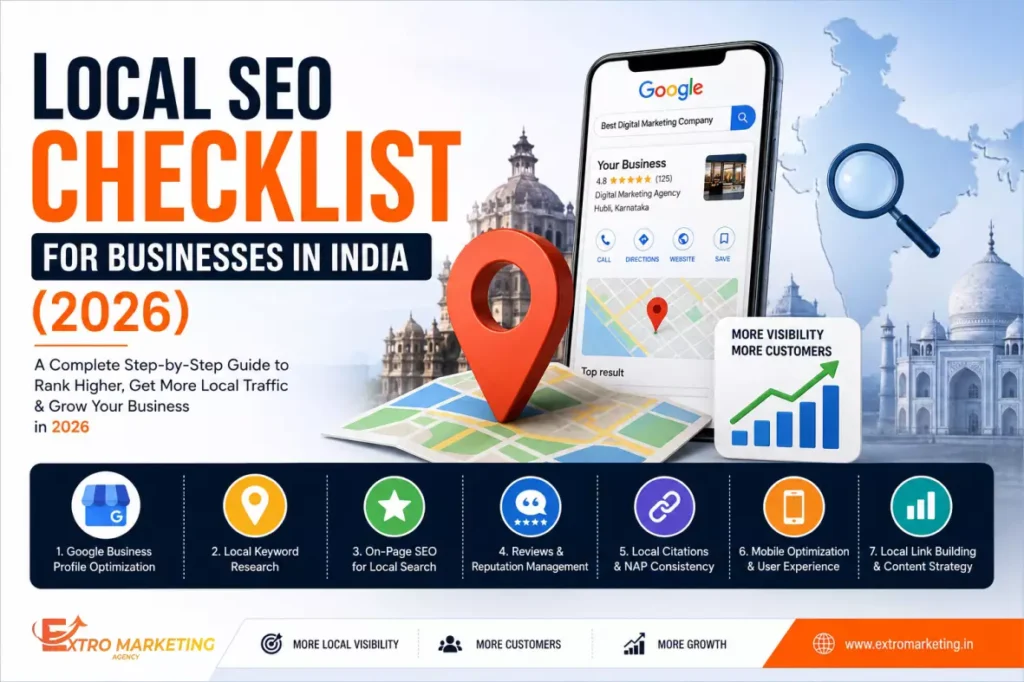
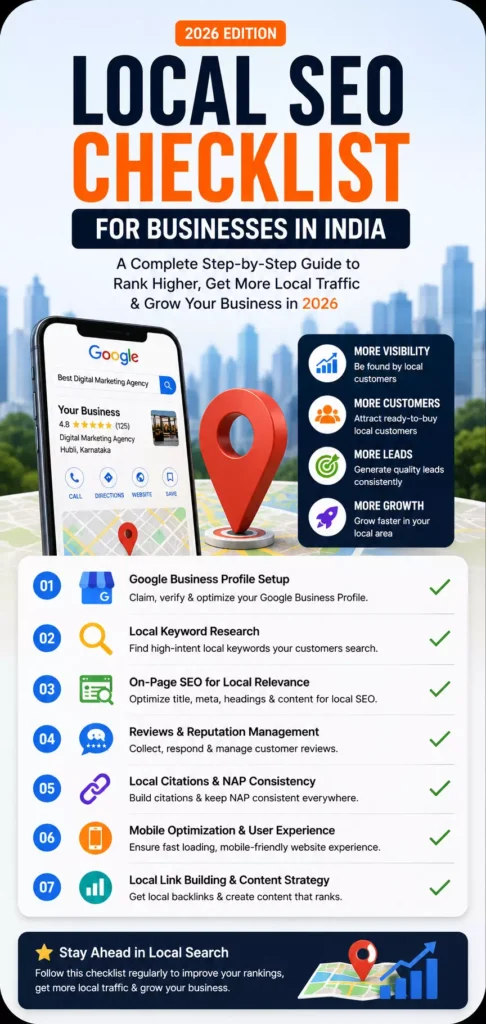
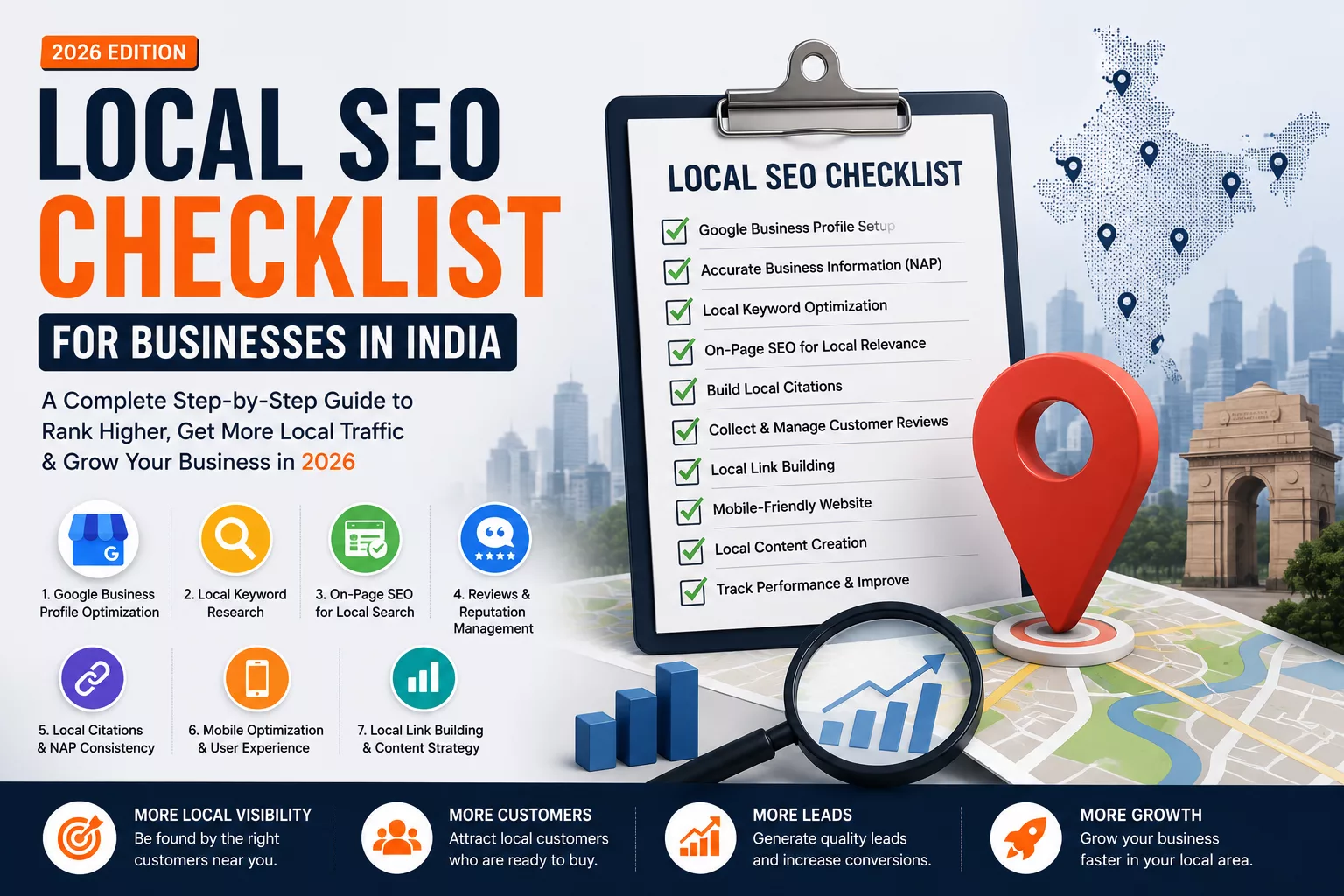
Local SEO Checklist for Businesses in India (2026): Rank Higher in Your City
If you run a local business in India – a clinic in Hubli, a jewellery store in Mysore, a travel agency in Bangalore, or a coaching institute in Belagavi, your customers are already searching for you on Google. The question is: are they finding you, or your competitor?
Here is the data that should get your attention:
46%
of all Google searches carry local intent, nearly half of all searches are people looking for businesses nearby.
76%
of people who search for something nearby visit a business within 24 hours.
41%
Increase in GBP actions (Calls, Directions, Website Visits) between 2025 - 2026
Local SEO is no longer optional for Indian businesses. It is the primary channel through which local customers discover, evaluate, and contact you.
This checklist covers every step you need to take in 2026 to rank higher in local search results, from Google Maps to AI search to voice queries. Use it as your step-by-step action plan.
What Is Local SEO and Why Does It Matter for Indian Businesses?
Local SEO (Local Search Engine Optimisation) is the process of optimising your online presence so that your business appears prominently when people in your city or area search for your products or services.
When someone in Hubli searches “digital marketing agency near me” or “best jewellery shop in Mysore,” Google shows a Local Pack — a map with three business listings — above all other results. Ranking in that Local Pack is the goal of local SEO.
Local search is no longer predictable, and businesses relying on outdated tactics feel it first. Modern local SEO focuses on intent, proximity, and trust rather than keyword tricks. Google rewards brands that meet real local needs with clear signals from profiles, pages, and user interactions.
In 2026, local SEO also means being visible to AI search systems — ChatGPT, Gemini, Claude AI, and Perplexity increasingly pull business information from Google Business Profiles, review data, and structured website content. If your local signals are weak, you are invisible on both traditional and AI search.
The Complete Local SEO Checklist for Indian Businesses (2026)
Google Business Profile (GBP) Optimization
Google Business Profile is the single most important local SEO asset for any Indian business. GBP optimisation is the single highest-leverage activity for most local businesses.
Checklist:
-
Claim and verify your GBP listing
Go to business.google.com and verify via postcard, phone, or video verification (available for most Indian businesses in 2026).
-
Business name matches exactly
Use your exact legal or trading name. No keyword stuffing (e.g., "Best Dentist Hubli Dr Sharma" is a policy violation and risks suspension).
-
Primary category is accurate
Choose the most specific primary category available (e.g., "Digital Marketing Agency" not just "Marketing Agency"). Add up to 9 secondary categories.
-
Complete address entered correctly
Use the exact format matching your website and all directory listings. Inconsistency across platforms hurts rankings.
-
Phone number is local
A local Karnataka or city-specific number signals stronger local relevance than a toll-free number.
-
Website URL linked
Link to your homepage or a dedicated location page if you have multiple branches.
-
Business hours accurate and updated
Include special hours for Indian holidays (Diwali, Republic Day, etc.).Businesses with updated visuals and accurate information generate higher engagement and more customer trust
-
Business description written
750 character limit. Include your primary service, city, and one key differentiator. Do NOT include URLs or promotional pricing in the description (GBP policy violation).
-
Products and services added
List each service with name, description, and price range. Google uses this to match your profile to relevant searches.
-
Photos uploaded regularly
Add interior, exterior, team, and product photos. Minimum 10 photos to start. Add new photos monthly.
-
Google Posts published weekly
Use the Posts feature to share offers, updates, and events. Active profiles rank higher than dormant ones.
-
Q&A section managed
Proactively add your own Q&As (common questions your customers ask). Monitor and answer questions from users promptly.
-
Messaging enabled
Turn on the GBP messaging feature so customers can WhatsApp or message you directly from Google Search. High engagement = ranking boost.
NAP Consistency — Name, Address, Phone Number
NAP consistency is one of the foundational local SEO signals. Google cross-references your business information across dozens of platforms to verify you are a legitimate, real business.
Checklist:
Audit all existing listings:
Search your business name + city on Google. Check every directory listing that appears (JustDial, Sulekha, IndiaMart, Yellow Pages India, Practo, if healthcare).
NAP identical everywhere:
Even minor differences (“Hubli” vs “Hubballi”, “2nd Floor” vs “Second Floor”) create inconsistency signals. Standardise across all platforms.
Submit to top Indian directories:
- JustDial (justdial.com)
- Sulekha (sulekha.com)
- IndiaMart (if product-based)
- Yellow Pages India
- TradeIndia
- Clutch.co (for service agencies)
- GoodFirms (for tech/marketing agencies)
Submit to global directories:
- Bing Places for Business (free, direct Maps visibility on Bing)
- Apple Maps Connect (significant for iPhone users in India)
- Facebook Business Page (address + hours + category)
- LinkedIn Company Page (address + services)
Remove or merge duplicate listings
Duplicate GBP listings split your review equity and confuse Google. Report and remove duplicates via GBP support.
Online Reviews — The #1 Trust Signal
87%
Of consumers read online reviews for local businesses in 2026. Businesses with fewer than 10 reviews or an average rating below 4.0 stars face a measurable conversion penalty.
Reviews are not just social proof, They are a direct ranking signal in 2026.
- Actively request reviews: 70% of customers will leave a review if asked. Most businesses never ask. Create a short review request message for WhatsApp: "Hi {Customer_name}, thank you for choosing {Your_Business_Name}. If you are happy with our service, we would appreciate a quick Google review — it takes 30 seconds and helps us a lot: {Your GBP review link}"
- Generate your review short link: In GBP dashboard → Share review form → copy link. Send this to every customer post-service.
- Target 5+ new reviews per month: consistency matters more than volume spikes. Steady monthly reviews signal an active, trusted business.
- Respond to every review: good and bad. Google evaluates what customers are saying, how recently they said it, and how your business responds. That is why reviews are one of the strongest trust signals in local SEO.
- Include keywords naturally in review responses: example: "Thank you for choosing our digital marketing services in Hubli, {Customer_Name}. We are glad our Google Ads campaign delivered the results you needed."
- Never buy fake reviews: Fake reviews and review extortion continue to damage local businesses. Google introduced stronger automated systems in 2026 to detect suspicious review activity and coordinated spam attacks. Fake reviews risk permanent GBP suspension.
- Report spam reviews: if competitors or bots leave fake negative reviews, use the GBP dashboard to flag and report them for removal.
Local Business Schema Markup
Schema markup is structured data that tells Google (and AI systems) exactly what your business is, where it is, and what it does.
Checklist:
- H1 includes primary keyword + city Example: "Digital Marketing Agency in Hubli, Karnataka", not just "Digital Marketing Agency."
- Title tag includes city: Example: SEO Services in Hubli, Karnataka | Extro Marketing
- Meta description includes city + service: Use the Yoast SEO/Rankmath SEO plugins to set this for every page.
- City mentioned in first 100 words: Google reads the opening content heavily for topical and geographic relevance signals.
- Contact page has full NAP: Name, address, phone, email, map embed. Must match GBP exactly.
- Google Maps embed on contact page: Embed your GBP location directly on the contact page. Strengthens geo-association.
- Footer NAP on every page: Your address and phone number should appear in the footer across all pages, not just the contact page.
- Location-specific landing pages: If you serve multiple cities (Hubli + Bangalore + Mysore), create a dedicated page for each city with unique, localised content. Do not duplicate the same page with only the city name changed.
- Internal links use location anchor text: Link to your contact page using "contact our Hubli office" rather than just "contact us."
On-Page Local SEO — Your Website
Your website must send clear local relevance signals to Google. A great GBP listing with a weak website will underperform.
Checklist:
- Add Local Business JSON-LD to homepage: include: name, url, telephone, email, address (streetAddress, addressLocality, addressRegion, postalCode, addressCountry), geo coordinates, openingHours, priceRange, and serviceArea.
- Add Service schema to each service page: tells Google the specific service offered, its description, and the provider.
- Add FAQ Page schema to homepage and service pages: FAQ rich snippets increase click-through rate and are a primary signal for AI search citations.
- Add FAQ Page schema to homepage and service pages: FAQ rich snippets increase click-through rate and are a primary signal for AI search citations.
- Add Review/Aggregate Rating schema: if you display testimonials on your website, mark them up with schema so Google can display star ratings in search results.
- Validate schema: paste your JSON-LD into schema.org/SchemaValidator and Google's Rich Results Test (search.google.com/test/rich-results) before publishing.
- Deploy via Code Snippets plugin (WordPress): add each schema block and restrict it to its specific page URL. Do not add Local Business schema to every page — homepage only.
Mobile SEO and Core Web Vitals
Many stats show that about three-quarters of local mobile searches result in a store visit or call within 24 hours. If your website is slow or broken on mobile, you are losing those customers at the moment of highest intent.
Checklist:
- Run Page Speed Insights: Go to pagespeed.web.dev and test your homepage. Target: LCP under 2.5 seconds, CLS under 0.1, INP under 200ms.
- Mobile-responsive design: test every page on a real Android and iPhone device. Check forms, buttons, and CTAs are tappable without zooming.
- Image optimisation: compress all images to WebP format. Use lazy loading for images below the fold. Large unoptimised images are the #1 cause of slow LCP in India.
- Image optimisation: compress all images to WebP format. Use lazy loading for images below the fold. Large unoptimised images are the #1 cause of slow LCP in India.
- Caching plugin active: WP Rocket, LiteSpeed Cache, or W3 Total Cache. Clear cache after every content update.
- HTTPS active: SSL certificate must be valid. Google flags non-HTTPS sites in local search.
- Phone number clickable: Use tel: links () so mobile users can call in one tap.
- WhatsApp click-to-chat: Add a WhatsApp chat button (wa.me link). Indian customers strongly prefer WhatsApp for first contact with local businesses.
Local Content Strategy
Content is what separates businesses that rank in the top 3 from those stuck on page 2. In 2026, Google looks for clear signs that you are a real, reliable business. If your site and profiles send strong trust signals, your keywords do not need to be forced.
Checklist:
- Publish localized blog content: write educational posts targeting local searches: "How to choose a digital marketing agency in Hubli," "SEO tips for small businesses in Karnataka," "Google Ads cost for real estate in India."
- Minimum 1 blog post per month: Consistency signals an active, authoritative business. Google rewards regularly updated websites.
- Target hyperlocal keywords: Go beyond city-level to area-level: "Vidyanagar Hubli digital marketing," "Sadashivanagar Bangalore SEO agency," "Koramangala website developer."
- Create a local resource page: A page covering "Digital Marketing for Businesses in Hubli" or "Small Business Growth Guide for Karnataka" earns local authority and backlinks from other local sites.
- Mention local landmarks and context: Content that references recognisable local context (BVB College, Dharwad road, Gokul Road) signals geographic authenticity to Google's AI systems.
- Add E-E-A-T signals: Author name, designation, and photo on every blog post. Link to the author's LinkedIn profile. This is a direct signal Google uses to evaluate content credibility.
Local Backlinks and Citations
In 2026, Google places more weight on contextual relevance — links from local news outlets, chambers of commerce, and niche directories carry more authority than generic backlinks.
Checklist:
- Get listed in local business associations: Hubli Chamber of Commerce, Karnataka MSME associations, local industry bodies. These are high-trust local citations.
- Earn press coverage: Use awards and milestones (e.g., Bangalore Excellence Award 2025) as hooks for local news coverage. Karnataka-based business publications and news portals are valuable link sources.
- Guest post on Indian industry blogs: Write useful content for marketing, business, or industry-specific Indian blogs with a link back to your relevant service page.
- Sponsor local events: Event pages that list sponsors with website links are quality local backlinks.
- Get university or college mentions: If you offer internships, speak at events, or train students (KLE Tech, BVB College, etc.), request a mention with a link on their website.
- Partner page links: Request a listing on the Google Partners directory and Meta Business Partner directory — both are high-authority links from Google and Meta's own domains.
AI Search and Voice Search Optimization
Google explicitly says SEO fundamentals remain relevant for AI features like AI Overviews. But AI search also rewards structured, answer-first content that local SEO sites traditionally lack.
Checklist:
- Write FAQ content in answer-first format: Start every FAQ answer with the direct answer in the first sentence. AI systems extract the first complete sentence as the response.
- Target conversational queries: Optimize for how people speak: "Which is the best digital marketing agency near me in Hubli?" not just "digital marketing agency Hubli."
- Optimize for "near me" searches: Ensure your GBP location is pinned accurately. "Near me" results are driven by GBP proximity + engagement signals.
- Keep GBP data accurate for AI agents : Keep your Google Business Profile hours and services updated so AI agents trust the data they read. AI systems like Google's AI Overview and third-party agents pull directly from GBP.
- Add speakable schema: For content designed to be read aloud (FAQ answers, key facts), speakable schema helps voice assistants (Google Assistant, Siri) surface your content.
- Answer "who/what/where/when/why/how" for your business: These are the question formats AI systems most commonly return answers for. Build a page or FAQ section that answers: What is {your business}? Where are you located? What services do you offer? How much do you charge?
Tracking and Measurement
Local SEO without measurement is guesswork. Track these every month.
Checklist:
- Google Search Console verified: Submit sitemap, check for indexing errors, monitor local keyword impressions and clicks.
- Google Analytics 4 installed: Track organic traffic by city/region. Monitor which local pages drive the most sessions and conversions.
- GBP Insights reviewed monthly: Check profile views, search queries used to find your profile, direction requests, phone calls, and website clicks. These show real local demand.
- Track local keyword rankings: Use a rank tracker (Ubersuggest, Semrush, or Google Search Console) to monitor your position for primary local keywords monthly.
- Monitor review score monthly: Track average star rating, total review count, and response rate. Set an alert if your rating drops below 4.2.
- Competitor GBP audit quarterly: Check your top 3 local competitors' GBP profiles. Note their review count, post frequency, photo count, and service listings. Identify gaps you can close.
Common Local SEO Mistakes Indian Businesses Make in 2026
Avoid these — they actively hurt your rankings:
- Keyword stuffing in GBP name: "Best Dentist Hubli Dr Sharma Clinic Teeth" violates GBP guidelines and risks suspension.
- Inconsistent NAP across platforms: Even "Hubli" vs "Hubballi" creates a mismatch signal that weakens local authority.
- Buying fake reviews: Google's 2026 anti-spam systems are significantly stronger. Fake review patterns are detected and result in GBP suspension.
- Duplicate GBP listings: Two listings for the same business split your review equity and confuse Google about your true location.
- No response to negative reviews: Ignoring negative reviews signals poor customer service to both Google and future customers.
- Same content on multiple city pages: Creating 20 city pages with only the city name swapped is a thin content pattern Google's Helpful Content system specifically targets.
- Ignoring Core Web Vitals: A slow Elementor or WordPress site that loads in 5+ seconds on mobile is actively penalised in local ranking.
How Extro Marketing Agency Helps You Rank Locally
At Extro Marketing Agency, we are a certified digital marketing agency in Hubli and a Google Partner. Our SEO services include:
- Full Google Business Profile setup, optimisation, and monthly management
- NAP audit and citation cleanup across Indian and global directories
- LocalBusiness, FAQPage, and Service schema implementation
- Location-specific landing page creation and optimisation
- Monthly local keyword rank tracking and GBP Insights reporting
- Review generation strategy and response management
- Integration with Google Ads, Facebook and Instagram Ads, and social media management for full-funnel local visibility
We have helped real estate businesses, jewellery stores, travel agencies, education institutes, and healthcare providers across Karnataka rank in Google’s Local Pack for their target keywords.
Frequently Asked Questions: Local SEO in India
Local SEO optimises your online presence to appear in location-based searches — like "dentist near me" or "digital marketing agency in Hubli." Regular SEO targets broader keywords without geographic intent. Local SEO specifically targets Google's Local Pack (map results), Google Business Profile, and location-based organic results. It is the most important SEO strategy for any business serving customers in a specific city or region in India.
Initial improvements in Google Business Profile visibility appear within 2–4 weeks of optimisation. Local keyword ranking improvements typically take 60–90 days. Ranking in the top 3 of Google's Local Pack for competitive keywords in major Indian cities takes 3–6 months of consistent effort. New businesses or those in less competitive Tier 2 cities like Hubli or Dharwad often see faster results.
There is no fixed minimum, but businesses with fewer than 10 reviews face a significant ranking disadvantage. For competitive local searches in Indian cities, aim for 25–50 reviews with an average of 4.2 stars or above. More important than total count is recency — 5 new reviews this month outweigh 50 reviews from 2022 in Google's current algorithm.
Yes. Google Business Profile is completely free for all businesses in India. There is no paid tier or subscription. You create and manage your profile at business.google.com at zero cost. The only investment required is time — or the management fee of a local SEO agency if you hire one to optimise and manage it.
A website is not strictly required to appear in Google's Local Pack — your GBP listing alone can rank. However, a website significantly strengthens your local SEO by providing additional location signals, indexed content, schema markup, and conversion pages. Businesses with optimised websites consistently outrank those with GBP-only profiles for competitive local keywords.
Other Services:
Have Any Question
Start building your dream website today. Contact us for a free consultation.
Published: June 2026 | Author: Darshan Badiger, Website Developer, Extro Marketing Agency | Hubballi, Karnataka, India
Read Our Latest Blogs & Insights
We deliver breaking news, in-depth analysis and insightful commentary on a wide range of topics, ensuring you always stay informed.
Google Ads for Real Reels
Best Digital Marketing Agency in Hubli